
Research topics
We study the molecular mechanism of polar auxin transport and how metabolic and transport processes regulate intracellular auxin homeostasis.
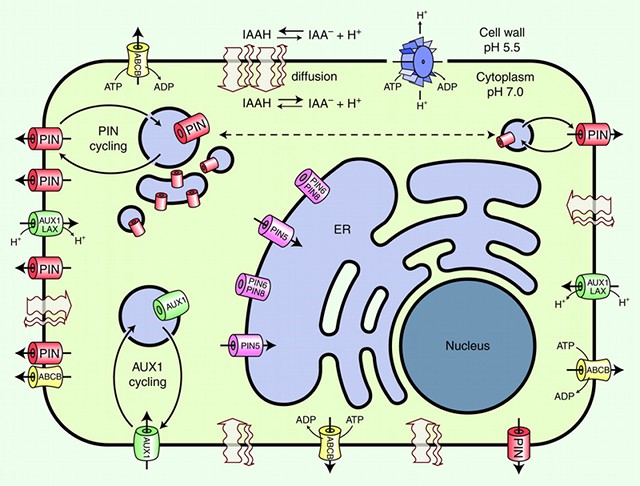
The plant hormone auxin is a key regulator of many developmental processes in plants. It governs the spatial and temporal aspects of plant growth, helping to coordinate and integrate development. Unlike other plant hormones, auxin is distinctive in that its molecules are transported over long distances in some tissues, and this transport is polar — directional, from cell to cell. The mechanism of this polar auxin transport is highly complex, regulated at multiple levels, and gives rise to auxin gradients (auxin maxima) within the plant. These gradients are shaped not only by intercellular transport but also by mechanisms regulating auxin homeostasis inside the cell — auxin transport across intracellular membranes together with the metabolic processes that interconvert its active and inactive forms.
Recent highlights
Auxin transport in phloem development. A long-running collaboration with the Hardtke laboratory (University of Lausanne) traces how polar auxin transport shapes the developing phloem: from discovering how a BRX–PAX–PIP5K module polarizes PIN carriers in sieve elements, through showing that ectopic assembly of this machinery redirects developmental trajectories, to our most recent finding that sieve element maturation is completed by a rapid, cell-to-cell auxin/PIN expulsion mechanism.
Auxin homeostasis and inactivation. We dissect how plants keep auxin levels in check by degrading it — from DAO-catalysed oxidation of IAA–amino acid conjugates to, more recently, how distinct GH3 enzyme subgroups route auxin inactivation through either aspartate or glutamine conjugation.
Evolutionary origins of auxin transport. With Stanislav Vosolsobě and Katarina Kurtović, we trace carrier-based auxin transport into the streptophyte algae. We established the alga Chara braunii as a tractable model and showed it possesses functional, IAA-responsive PIN-type transporters — pushing carrier-based auxin transport deeper into plant evolutionary history. This line also fed a broader phytohormone-profiling resource spanning the plant lineage.
Auxin habituation in cultured cells. We also ask why cultured cells lose their dependence on external auxin. Habituation involves upregulation of the auxin receptor TIR1, allowing proliferation independent of added hormone.
Team










JŠ
Jiří Švehla
Master student
Selected publications
Balakireva AV, Karataeva TA, , Mitiouchkina TY, Morozov VV, , Shakhova ES, Perfilov MM, Belozerova OA, Kovalchuk SI, Palkina KA, , , Müller K, Kalachova T, Fleiss A, Fernandez-Moreno JP, Alonso JM, Stepanova AN, Fakhranurova LI, Markina NM, Gorbachev DA, Bugaeva EN, Delnova GM, Choob VV, Yampolsky IV, , Mishin AS, Sarkisyan KS (2026) Non-invasive imaging of defence responses in plants. Nature Communications, 17:6393. DOI: 10.1038/s41467-026-70075-1
, Dalecká M, Drs M, Müller K, , Kashkan I, Aliaga Fandino AC, , Malínská K, Li K, , Benda A, , Hardtke CS (2026) Rapid cell-to-cell expulsion completes phloem sieve element maturation. Current Biology. DOI: 10.1016/j.cub.2026.06.042
, Ušák D, , Dobrev PI, , , Brunoni F, Moravec T, Müller K, (2026) GH3 phylogenetic subgroups define divergent routes of auxin inactivation via aspartate and glutamine conjugation. Plant Physiology, kiag412. DOI: 10.1093/plphys/kiag412
Kurtović K, , Vosolsobě S (2025) Optimized laboratory maintenance and functional testing of Chara braunii. Current Protocols, 6(1): e70279. DOI: 10.1002/cpz1.70279
Jelínek P, Müller K, Kobercová E, Přibylová A, , Dobrev PI, , , , , Fischer L, (2026) A novel mechanism of auxin habituation: upregulation of auxin receptor TRANSPORT INHIBITOR RESPONSE 1 allows cell proliferation independent of external auxin. New Phytologist, 249(3): 1268-1282. DOI: 10.1111/nph.70763
Kurtović K, Vosolsobě S, , , Dobrev PI, , Piszczek P, Kuhn A, Smoljan A, Fisher TJ, Weijers D, Friml J, Bowman JL, (2025) The role of indole-3-acetic acid and characterization of PIN transporters in complex streptophyte alga Chara braunii. New Phytologist, 246(3): 1066-1083. DOI: 10.1111/nph.70019
, Skokan R, Depaepe T, Kurtović K, Haluška S, Vosolsobě S, Vaculíková R, Pil A, Dobrev PI, Motyka V, Van Der Straeten D, (2024) Phytohormone profiling in an evolutionary framework. Nature Communications. DOI: 10.1038/s41467-024-47753-z
Aliaga Fandino AC, , Marhava P, , Hardtke CS (2024) Ectopic assembly of an auxin efflux control machinery shifts developmental trajectories. The Plant Cell. DOI: 10.1093/plcell/koae023
Kurtović K, , Nehasilová M, Vosolsobě S, (2023) Rediscovering Chara as a model organism for molecular and evo-devo studies. Protoplasma. DOI: 10.1007/s00709-023-01900-3
, Dobrev PI, Pěnčík A, Hošek P, , Filepová R, Malínská K, Brunoni F, , Moravec T, Retzer K, Harant K, Novák O, Hoyerová K, (2021) DIOXYGENASE FOR AUXIN OXIDATION 1 catalyzes the oxidation of IAA amino acid conjugates. Plant Physiology. DOI: 10.1093/plphys/kiab242
Serre NBC, Wernerová D, Vittal P, Dubey SM, Medvecká E, , , Grossmann G, Fendrych M (2023) The AUX1-AFB1-CNGC14 module establishes a longitudinal root surface pH profile. eLife. DOI: 10.7554/eLife.85193
El Houari I, Klíma P, Baekelandt A, Staswick PE, Uzunova V, Del Genio CI, Steenackers W, Dobrev PI, Filepová R, Novák O, Napier R, , Inzé D, Boerjan W, Vanholme B (2023) Non-specific effects of the CINNAMATE-4-HYDROXYLASE inhibitor piperonylic acid. The Plant Journal. DOI: 10.1111/tpj.16237
Kashkan I, Hrtyan M, Retzer K, Humpolíčková J, Jayasree A, Filepová R, , Simon S, Rombaut D, Jacobs TB, Frilander MJ, Hejátko J, Friml J, , Růžička K (2021) Mutually opposing activity of PIN7 splicing isoforms is required for auxin-mediated tropic responses in Arabidopsis thaliana. New Phytologist. DOI: 10.1111/nph.17792
Vosolsobě S, , (2020) The evolutionary origins of auxin transport: what we know and what we need to know. Journal of Experimental Botany. DOI: 10.1093/jxb/eraa169
Tan S, Di Donato M, Glanc M, Zhang X, Klíma P, Liu J, Bailly A, Ferro N, , Geisler M, Friml J (2020) Non-steroidal anti-inflammatory drugs target TWISTED DWARF1-regulated actin dynamics and auxin transport-mediated plant development. Cell Reports. DOI: 10.1016/j.celrep.2020.108463
Collaborators (recent and ongoing)
We highly appreciate the collaboration with other laboratories, in particular with
- Prof. Jiří Friml (IST Austria)
- Prof. Eva Benková (IST, Austria)
- Prof. Angus Murphy (University of Maryland, USA)
- Ass. Prof. Wendy Peer (University of Maryland, USA)
- Prof. Alain Gojon and Dr. Philippe Nacry (Institut de Biologie Intégrative des Plantes, CNRS/INRA, Montpellier, France)
- Prof. Richard M. Napier (School of Life Sciences, University of Warwick, UK)
- Prof. Christoph Ringli (Institute of Plant Biology, University of Zurich, Switzerland)
- Dr. Bartel Vanholme (Department of Plant Systems Biology, VIB, Ghent, Belgium)
- Prof. Martin Hof (J. Heyrovský Institute of Physical Chemistry, CAS, Prague)
- Assoc. Prof. Christian Luschnig (BOKU, Vienna, Austria)
- Assoc. Prof. Jürgen Kleine-Vehn (BOKU, Vienna, Austria)
- Prof. Christian S. Hardtke (University of Lausanne, Switzerland)
- Prof. Ondřej Novák (Palacký University & Institute of Experimental Botany, Laboratory of Growth Regulators, Olomouc, Czechia)
Latest
-
A Czech-Swiss team led by LHR’s Adriana Jelínková, with co-author Jan Petrášek, has found that developing phloem sieve elements expel their remaining cell contents into neighbouring cells in a rapid final step that completes their maturation, published in Current Biology. Read the ÚEB feature →
-
An international team including LHR postdoc Michael Karampelias, who has led the lab’s bioluminescence research since 2021, engineered plants that glow in the dark, with light intensity signalling the levels of two hormones central to plant defence, published in Nature Communications. Read the ÚEB feature →
-
Adriana’s phloem paper is out in Current Biology — a great capstone to years of work with the Hardtke lab in Lausanne on how sieve elements finish maturing. 10.1016/j.cub.2026.06.042

-
Lenka’s GH3 paper is out in Plant Physiology! She mapped how different GH3 enzymes split the job of switching auxin off, via aspartate or glutamine conjugation. 10.1093/plphys/kiag412
-
Mike, Nikola and Zuzka helped build a glow-in-the-dark way to watch plants fight off attackers in real time, published in Nature Communications.
-
We figured out why some cultured cells stop caring about auxin altogether: they just make more TIR1 receptor. Out now in New Phytologist.
-
LHR head Jan Petrášek and colleagues — including team members Anita Bírošíková and Milada Čovanová — described a surprising genetic mechanism that lets tobacco cell cultures grow and divide without the otherwise essential hormone auxin, a case of “evolution in a test tube.” Read the ÚEB feature →
-
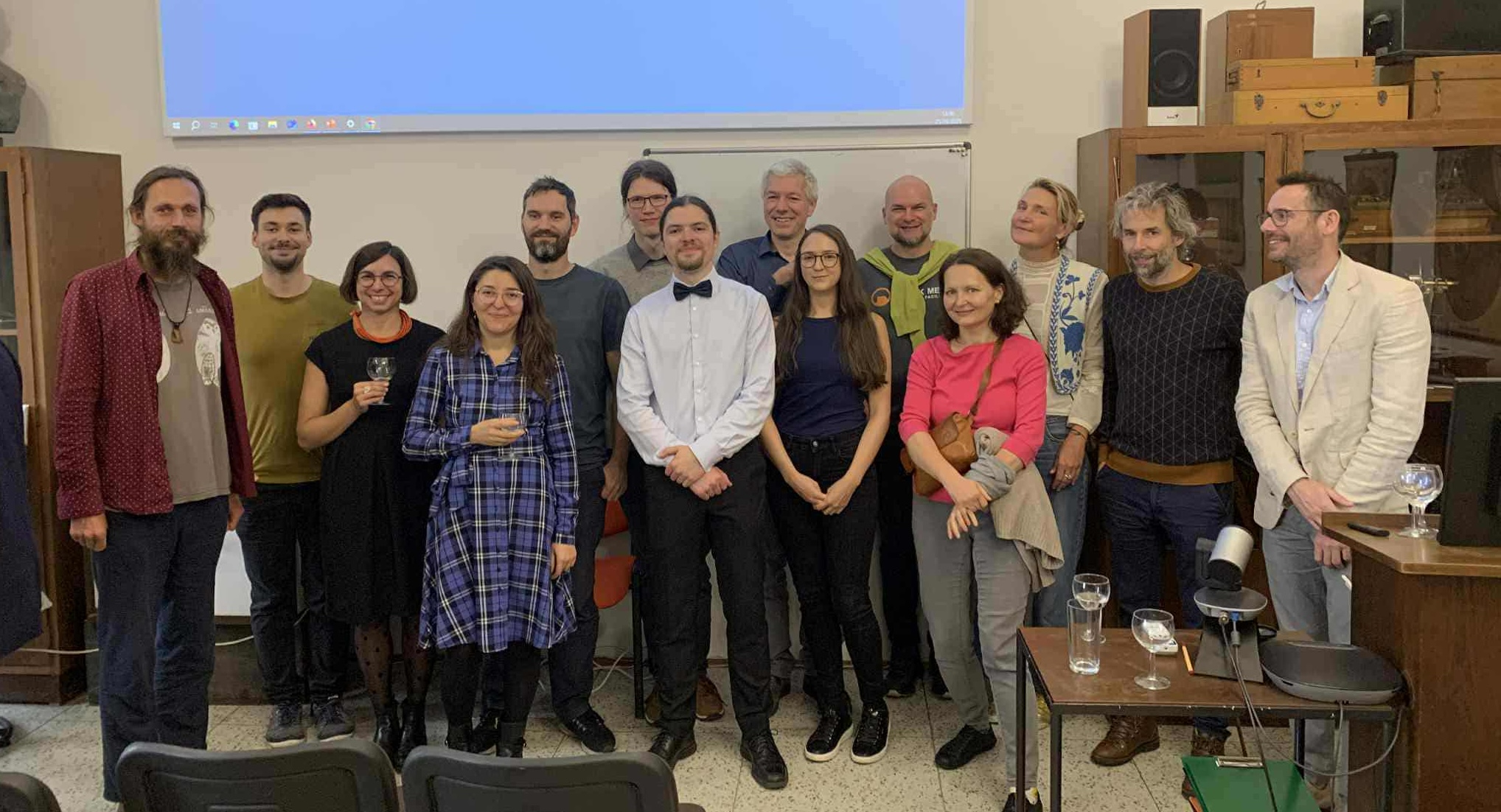
Vojtěch successfully defended his Ph.D. thesis, “The Evolutionary Origins of Auxin Action”! Thanks to Isabel Monte and Anthony Bishopp for travelling to Prague to serve as reviewers. Congratulations, Dr. Schmidt!
-
Our Chara braunii paper is out in New Phytologist — this alga turns out to have real, working PIN-type auxin transporters. 10.1111/nph.70019
-
ÚEB opened its doors for public lab tours, including LHR’s “Dark Lab” station showing off bioluminescent plants that glow to reveal their internal hormone signals (in Czech). Read the ÚEB feature →
-
Mike brought glow-in-the-dark Arabidopsis to DARK LAB for the Academy of Sciences’ open-doors festival at IEB — a bioluminescent plant that tells you how it’s feeling. More on X.

-
Research with ÚEB, Charles University, and Ghent University found that plant hormones already occur in freshwater green algae, though they likely gained their growth-regulating functions only after plants moved onto land. Read the ÚEB feature →
-
Vojta put together a phytohormone-profiling resource spanning the whole plant evolutionary tree, now out in Nature Communications. 10.1038/s41467-024-47753-z
-
Another one from the Lausanne collaboration: Ana Cecilia and Adriana show that forcing the auxin efflux machinery into the wrong place reroutes development. Published in The Plant Cell.
-
Marking its 70th anniversary, the University of Chemistry and Technology Prague awarded an honorary doctorate to Eva Zažímalová — who led LHR for many years before becoming ÚEB director and chair of the Czech Academy of Sciences — recognising her work on the hormone auxin (in Czech). Read the ÚEB feature →
-
An international team led on the Czech side by LHR head Jan Petrášek traced a chain of steps linking changes in the cell membrane to regulation of auxin flow, published in Nature Plants (in Czech). Read the ÚEB feature →
-
Eva Zažímalová — who led LHR for many years before becoming ÚEB director and, since 2017, chair of the Czech Academy of Sciences — won the Public Administration category of the Top Women of the Czech Republic awards for her work on plant hormones (in Czech). Read the ÚEB feature →
-
LHR head Jan Petrášek’s team — with lab colleagues Klára Hoyerová, Petr Hošek, and Michaela Helusová among the co-authors — showed how plant cells regulate their internal auxin concentration by controlling the activity of transport-protein genes, published in The Plant Journal (in Czech). Read the ÚEB feature →
-
Czech and Austrian researchers, with LHR head Jan Petrášek among the co-authors, described how brassinosteroid hormones regulate the auxin-transport protein PIN2 in root cells, revealing dynamics quite different from what was previously assumed, published in Nature Communications (in Czech). Read the ÚEB feature →
-
LHR’s Jan Petrášek appeared on Czech Television’s Studio 6 to discuss his team’s discovery linking the hormone auxin to membrane biochemistry, and the pleasures of microscopy (in Czech). Read the ÚEB feature →
-
An international team led by Jiří Friml, with LHR head Jan Petrášek among the co-authors, traced the evolutionary origins of the auxin transport and signalling system that shapes plant growth, finding its roots surprisingly deep in evolutionary history (in Czech). Read the ÚEB feature →